
Kandinsky, the Music of Colours - Philharmonie de Paris

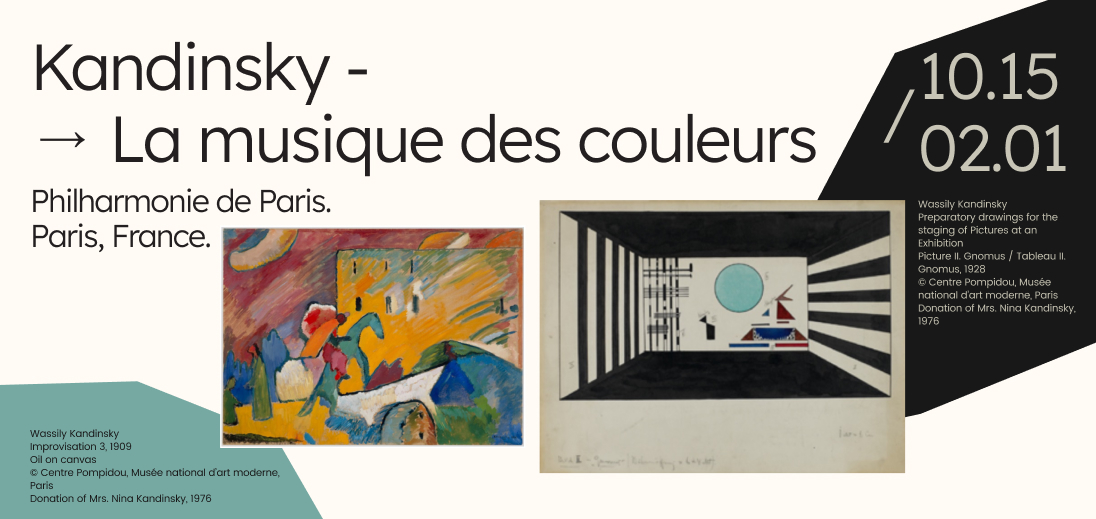
Kandinsky, the Music of Colours exhibition, the Musée de la Musique - Philharmonie de Paris is an immersive exhibition like no other.
Kandinsky, the Music of Colours exhibition, the Musée de la Musique - Philharmonie de Paris is an immersive exhibition like no other.
Must see show: Kandinsky, the Music of Colours - Musée de la musique - Philharmonie de Paris
Appreciating a work of art is often thought to be a silent act. A quiet moment of contemplation during which the viewer carefully and thoughtfully analyses the work. This traditional methodology by which to appreciate art has been completely discarded by a new celebration of the abstract pioneer Wassily Kandinsky.
With The Music of Colours exhibition, the Musée de la Musique - Philharmonie de Paris has teamed up with the Centre Pompidou to give art lovers an experience that will delight the senses. Almost 200 of the artist’s works and objects from his life will be displayed and set to music. The exhibition is a wondrous sonic and visual celebration of the great master and a reverent acknowledgement of the importance that the master himself placed on music.
This innovative initiative is the first time this remarkable artist’s work has been interpreted through musical compositions originating from the same historical period as his own. The exhibition runs from October 15, 2025, to February 1, 2026.
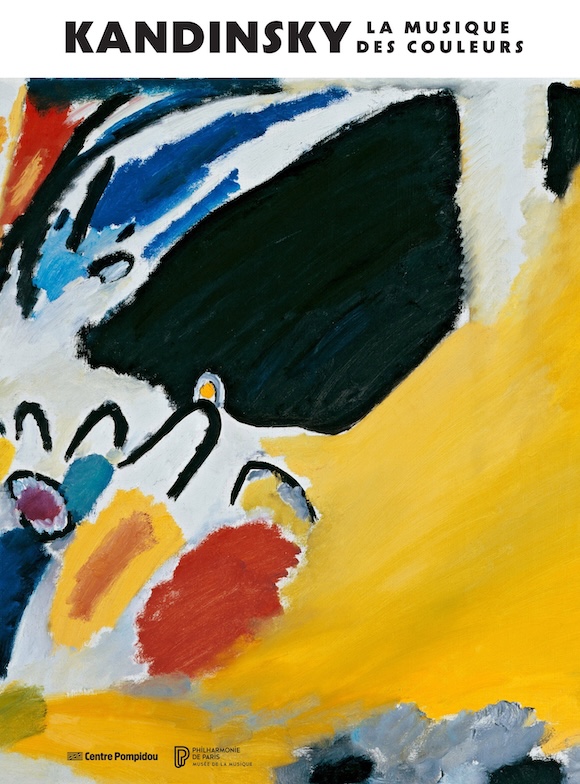
Close-up of the cover of the exhibition catalogue "Kandinsky. The Music of Colours"
How music impacted Wassily Kandinsky
"Colour is the keyboard, the eyes are the hammers, the soul is the piano with many strings. The artist is the hand that plays, touching one key or another purposely, to cause vibrations in the soul" - Wassily Kandinsky.
Kandinsky’s art is often referred to as a ‘symphony of colours’. This description reflects the depth of the connection between the artist and music. Indeed, his relationship with music was far from ordinary.
Music had an exceptionally strong impact on the artist due to the rare condition of synaesthesia. Synaesthesia is an uncommon neurological condition where one sensory or cognitive pathway can trigger another sensory or cognitive pathway. People with synaesthesia often describe the taste of words or experience sound as colours. When the artist heard a piece of music, he saw colours dancing in front of his eyes. Likewise, when he painted, he heard beautiful music with each brushstroke.
The composer Arnold Schoenberg was also a profound influence. Schoenberg's often atonal pieces reflected the painter’s own unique experience of the world. There was also a famous episode known as the ‘Wagner Effect’. This refers to a prolonged synesthetic experience the artist had at a performance of Richard Wagner's opera Lohengrin at the Bolshoi Theatre. The intense hallucinatory images he saw convinced him that painting could possess the same spiritual power as music.
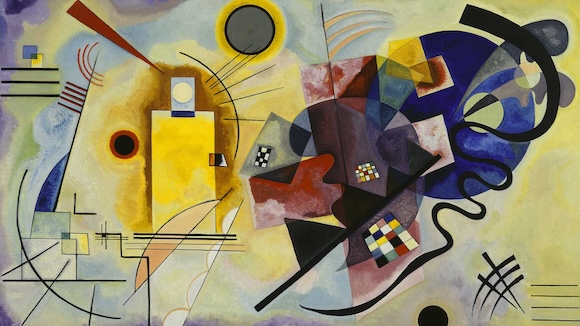 This incident was a pivotal moment in his life and inspired him to further explore the potential of abstract art and his concept of an artwork as a visual symphony. Kandinsky later went on to detail his theories on expressing inner spiritual and emotional realities through non-representational forms and colours in his book ‘Concerning the Spiritual in Art’.
Vassily Kandinsky, Jaune-rouge-bleu, 1925, Paris, © Musée national d’art moderne-Centre Pompidou
Kandinsky’s impact on the art world
It is difficult to understate the impact Kandinsky had on the art world. He was instrumental in moving art away from direct representations of the visual world and into a more emotive, dreamlike, abstract way of expressing reality and the artist’s spiritual and emotional experiences.
He was a founding member of the German Expressionist group Der Blaue Reiter (The Blue Rider) and was also a member of the Bauhaus school.
His influence was also reflected in American Hard Edge painting and Op Art. He was a major inspiration for artists such as Jackson Pollock and Mark Rothko.
The spiritual dimension that he championed in art still guides contemporary artists in their pursuit of personal expression and higher meaning. Today, the master’s ideas and creations are firmly established within the modern art tradition.
Kandinsky, the Music of Colours exhibition
The exhibition features around 200 works and objects, including paintings, drawings, musical scores, records, books, and studio tools. Visitors are taken from his early Russian landscapes to his final Compositions. Headphones provide a truly immersive fusion of sounds and shapes.
An imaginary cabinet reflects Kandinsky’s passion for music, displaying the scores he collected, music books, records, photos of musical friends, and engravings of favourite songs. At its centre, it features studio tools that highlight how the artist explored the musicality of his work, from the “sound” of colours to visual studies inspired by Beethoven’s 5th Symphony.
The exhibition also highlights word-melody poems, stage projects, and the essential Almanach du Blaue Reiter, a collaborative visual and musical manifesto. The exhibition concludes with re-enactments of key moments, including Mussorgsky’s Pictures at an Exhibition (1928) and the Berlin Music Salon (1931).