
Gustav Klimt – Pigment & Pixel exhibition

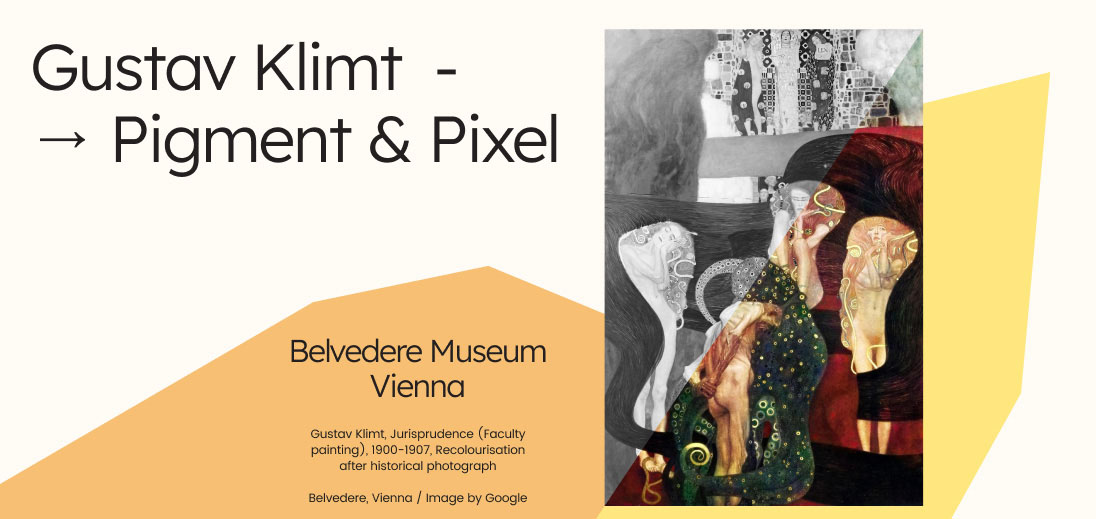
The Gustav Klimt – Pigment & Pixel exhibition recreates lost works from one of the art world’s revered masters.
The Gustav Klimt – Pigment & Pixel exhibition recreates lost works from one of the art world’s revered masters.
Must see show - Gustav Klimt – Pigment & Pixel / Rediscovering Art Through Technology
Gustav Klimt is one of the titans of the art world. A leading figure of the Modernist movement, Klimt focused on depictions of the female body and explored themes of longing, love, and the cycle of life. Klimt’s luxurious paintings were charged with eroticism and deep philosophical meaning. The overt sensuality of his work reflected the artist's belief that celebrating love and sexuality was essential to overcoming existential dread and the frailty of human life.
While perhaps now best known for his iconic painting ‘The Kiss’, Klimt produced a staggering body of work during his lifetime. The Belvedere Museum in Vienna, Austria, pays tribute to the great master’s achievements with the Pigment & Pixel / Rediscovering Art Through Technology exhibition.
The latest technological advances in diagnostic analyses and macroscopic photography have been employed to uncover Klimt’s processes. Visitors can learn exactly how Klimt applied his unique method of incorporating gold leaf into his paintings. Unseen preparatory drawings of an unfinished work are also revealed. However, the most remarkable aspect of the exhibition is the recreation of Klimt’s lost Faculty Paintings in their original colours.
The Pigment & Pixel / Rediscovering Art Through Technology exhibition is an astounding representation of how modern technology allows us to explore the process of the great masters and bring previously destroyed works back to life.
Using technology to uncover Klimt’s unique methods
Discovering how one of the grand masters of the art world created their works is a rare treat for art lovers. The Pigment & Pixel / Rediscovering Art Through Technology exhibition provides visitors with the fascinating opportunity to see exactly how Klimt achieved his distinctive Golden Style.
The exhibition uses macroscopic imagery to analyse the techniques behind one of Klimt’s most iconic paintings, the 1901 work ‘Judith’. This painting depicts the biblical Jewish heroine Judith and is thought to have been inspired by a play by Friedrich Hebbel.
The painting combines themes of sexuality and death, showing Judith as an alluring, dangerous figure cloaked in a translucent blue robe and surrounded by luxurious gold detail.
The Pigment & Pixel / Rediscovering Art Through Technology exhibition reveals that Klimt used actual flakes of 23.5-karat gold leaf to create his golden paintings. Viewers are shown the painstaking method Klimt used to precisely apply each flake of previous gold to the canvas.
The exhibition also reveals Klimt’s process of creating the portrait of Amalie Zuckerkandl who was the daughter of the prominent Viennese writer Sigmund Schlesinger. X-rays and reflectography technologies peel back the layers of paint to show the sketches and drawings that led to the final work. Never before has the methodology of the master been shown in such detail.
Bringing the lost faculty paintings back to life
In 1894, Klimt and the artist Franz Matsch were commissioned to create these paintings by the Austrian Ministry of Education. The paintings were to be displayed on the ceiling of the University of Vienna's festival hall. In total, the artists were asked to produce five paintings, four works depicting the University of Vienna’s faculties and one work to stand as a centrepiece.
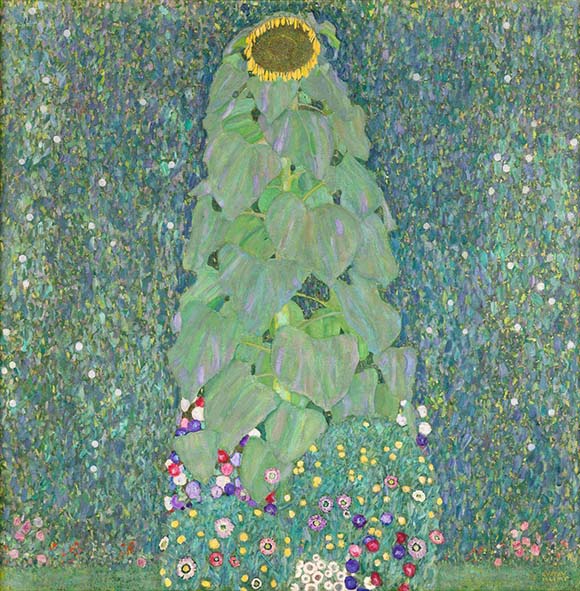 Gustav Klimt, Sunflower, 1907/1908
Source : Johannes Stoll / Belvedere, Vienna
Matsch worked on the centrepiece and the painting for the Religion faculty. Klimt produced works representing the faculties of Philosophy, Medicine, and Jurisprudence. These were massive paintings over four metres in height. Each painting features Klimt’s signature nude figures as well as detailed ornamental flourishes, and depictions of mythological figures.
Klimt’s paintings were unveiled in 1900 and caused an uproar amongst art critics and commentators. Seen as pornographic and interpreted as a mockery of the faculties by some, the paintings were incredibly controversial at the time.
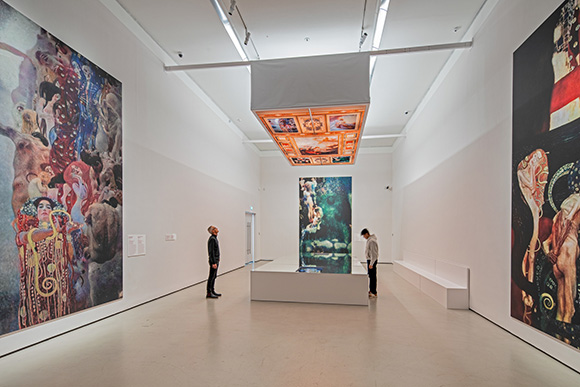
Installation view “Gustav Klimt - Pigment & Pixel. Rediscovering Art Through Technology”, Lower Belvedere
Source : Johannes Stoll / Belvedere, Vienna
During the Second World War, the Faculty Paintings were seized by the Nazis and held in Castle Immendorf in Lower Austria. On the 7th of May 1945, one day before the surrender of Germany, SS officers set the castle ablaze to stop the artworks from falling into the hands of the Russians. The only record of the paintings that remained were a few black and white photos.
Klimt’s Faculty Paintings were thought lost forever – until now. By collaborating with Google Arts & Culture and using advanced artificial intelligence programs, the Faculty Paintings have now been recreated in precise detail in their original colours.
Gustav Klimt – Pigment & Pixel – exhibition details
The Gustav Klimt – Pigment & Pixel / Rediscovering Art Through Technology exhibition is being shown at the Lower Belvedere Museum in Vienna, Austria. The exhibition runs from the 20th of February 2025 to the 7th of September 2025.